)
)
Investing in Smart Homes in Dubai: Is It Worth It in 2025 and beyond?
Everyone talks about Dubai's property boom reaching new heights. Premium locations, waterfront views, golden visa eligibility - the usual selling points. But here's what estate agents won't tell you: the real money in 2025 isn't in marble lobbies or infinity pools. It's in the mundane magic of automated blinds that adjust themselves at 2:47 PM to block the harsh afternoon sun, saving you hundreds of dirhams monthly on cooling costs.
Top Smart Home Investment Opportunities in Dubai 2025
The smart homes Dubai market has shifted dramatically from luxury novelty to investment essential. Properties with integrated automation systems now command premiums that would have seemed absurd just three years ago. Yet most investors still chase traditional metrics - square footage, view, developer reputation - while missing the technology factor that's quietly reshaping property values across the emirate.
Dubai Marina Properties with 40% Faster Sales
Marina properties equipped with full home automation systems are moving off the market at extraordinary speeds. We're talking about apartments that sell in 18 days versus the usual 30-day average for conventional units. The difference? Buyers walk into these spaces and watch the lights dim automatically as evening approaches, feel the AC adjust to their presence, and see their faces unlock the door. It's visceral.
What really seals these deals isn't the technology itself - it's the monthly utility statements showing 35% lower DEWA bills. Prospective buyers see those numbers and calculate the savings over five years. The maths is compelling.
Creek Harbour Smart Developments
Creek Harbour represents something different: purpose-built smart infrastructure from day one. These aren't retrofitted apartments with smart plugs stuck into regular sockets. The entire development runs on integrated systems where your apartment knows when you're five minutes from home (thanks to geofencing) and prepares accordingly. Temperature adjusts. Lights activate in sequence. Your preferred playlist starts streaming.
The ROI here comes from rental appeal. Tenants pay 8-12% premiums for these units. Not because they're tech enthusiasts, but because the convenience becomes addictive. Once someone lives with predictive climate control and automated security, going back to manual switches feels like downgrading from a smartphone to a rotary dial.
Emaar South Automated Communities
Emaar South takes smart home technology Dubai to community scale. Individual villas connect to neighbourhood-wide systems that optimise everything from irrigation schedules to security patrols. Your home's data contributes to collective efficiency - when multiple houses detect unusual activity patterns, security gets alerted faster than any individual system could manage.
But here's the kicker: insurance companies now offer 15-20% discounts on these properties. Lower break-in rates. Fewer water damage incidents (smart leak detection). Reduced fire risks. The savings compound year after year.
Dubai Hills Estate Tech-Integrated Villas
Dubai Hills villas with full automation packages are achieving something remarkable - they're attracting cash buyers who typically negotiate hard on price. These buyers aren't haggling because the technology adds quantifiable value. A villa with integrated solar panels, battery storage and smart energy management can achieve near-zero electricity costs during winter months. Show that to someone considering a 15-million-dirham purchase, and suddenly the extra 500,000 for the smart package seems trivial.
Honestly? The solar integration alone justifies the premium.
Business Bay Premium Smart Apartments
Business Bay tells a different story. Here, smart home solutions Dubai target the executive rental market - people who stay 3-6 months and pay premium rates for turnkey convenience. These apartments feature voice-controlled everything, from curtains to coffee makers. The building management can reset and reconfigure each unit between tenants remotely. No keys to collect. No instructions to memorise. Just walk in and start living.
Occupancy rates for these units hover around 92%, compared to 75% for standard apartments in the same towers. Do the maths on that difference over a year. It's substantial.
Investment Returns and Financial Benefits
Numbers don't lie, even when estate agents do. The financial case for smart home automation Dubai investments rests on hard data that's becoming impossible to ignore. Traditional property metrics still matter - location, size, quality - but technology multiplies their impact in ways that surprise even seasoned investors.
12-15% Rental Yields vs 8-10% Traditional Properties
Let's be brutally honest about rental yields. Most Dubai properties deliver respectable returns, but smart homes operate in a different league entirely. A two-bedroom apartment in JLT without automation might rent for 120,000 AED annually. The identical unit with integrated smart systems commands 140,000-150,000 AED. Same view. Same square footage. Different monthly income.
The gap widens in the short-term rental market. Airbnb data shows smart apartments achieve 30% higher nightly rates and maintain 20% better occupancy. Guests specifically filter for "smart home" amenities. They're willing to pay extra for keyless entry, automated climate control and voice-activated entertainment systems. These aren't luxury investment seekers - they're efficiency maximisers who value time over money.
30% Property Value Premium Analysis
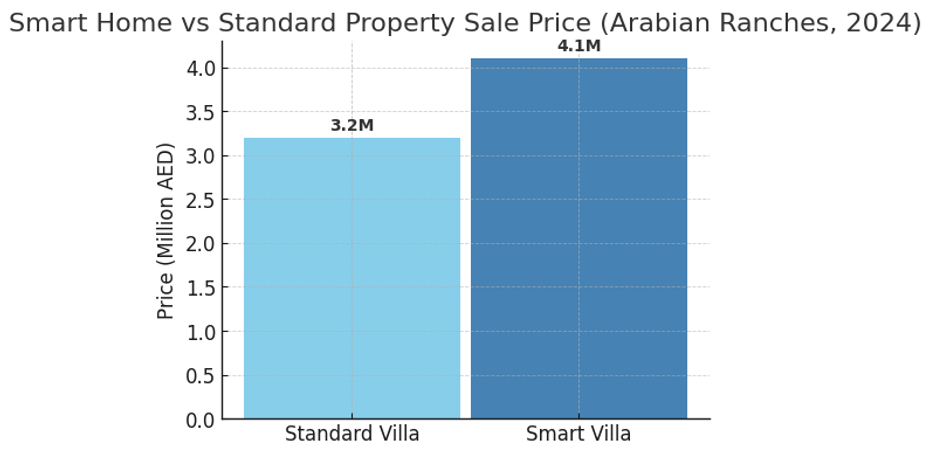
The 30% premium sounds inflated until you examine comparable sales. Take two identical villas in Arabian Ranches. One sold in March 2024 for 3.2 million AED - standard fixtures, manual everything. Its neighbour, retrofitted with comprehensive automation two years prior, sold the following month for 4.1 million AED. The automation installation cost the seller 180,000 AED. The return? Nearly 5x the investment.
But (and this matters) not all smart features create equal value. Buyers pay premiums for: • Integrated security systems with facial recognition • Whole-home climate automation • Smart lighting with circadian rhythm programming • Leak detection and automatic water shut-offs • Solar panels with battery storage
They barely notice: • Smart fridges • Automated pet feeders • Wi-Fi enabled washing machines
Focus your investment on systems that reduce costs or enhance security. Skip the gimmicks.
Energy Cost Savings of 30-40% Annually
Dubai's cooling costs can destroy a property's profitability. A typical three-bedroom villa runs up 2,000-3,000 AED monthly DEWA bills during summer. Smart climate control cuts that by 600-1,200 AED. Not through magic - through intelligence. The system learns your patterns, pre-cools before peak rate hours, adjusts room by room based on occupancy.
Here's what most people miss: the savings accelerate over time. The AI gets smarter. After six months, it knows that you work late on Wednesdays, that the guest bedroom stays empty except weekends, that you prefer sleeping at 23°C but can tolerate 25°C in the living room. Each insight translates to lower bills.
Maintenance Cost Reduction Through Predictive Systems
Predictive maintenance sounds like corporate jargon until your smart home alerts you about a failing AC compressor three weeks before it dies. Instead of an emergency repair at 3x the normal rate (because it's August and every AC technician in Dubai is booked solid), you schedule routine maintenance. The sensor that detected unusual vibration patterns? It cost 500 AED. The savings on that single prevented breakdown? 4,000 AED minimum.
These systems monitor everything - water pressure irregularities that signal pipe problems, electrical load patterns suggesting failing appliances, even subtle humidity changes indicating potential mould growth. They turn expensive surprises into manageable maintenance.
Think about it: what's the real cost of a water leak that goes undetected for a week while you're travelling?
Making Your Smart Home Investment Decision in Dubai
The evidence points clearly toward smart homes delivering superior returns, but success requires strategic thinking beyond just "add technology and profit." The Dubai market rewards investors who understand which technologies matter, which properties benefit most from upgrades and how to position smart features for maximum appeal.
Start with location and property type. High-traffic tourist areas favour automation that simplifies short-term rentals. Family communities benefit from security and energy efficiency. Business districts need convenience and productivity features. Match the technology to the tenant.
Timing matters too. The sweet spot for smart home investment in Dubai sits between off-plan purchase and handover. Developers often offer automation packages at cost during construction but charge substantial premiums for post-completion installations. A 100,000 AED package during construction might cost 180,000 AED as a retrofit. Same components. Same functionality. Very different impact on your ROI.
Finally, remember that smart homes Dubai investments work best as part of a broader strategy. They amplify good properties but can't rescue bad ones. A smart home in a declining area remains a declining asset - just with fancier switches. Choose properties with fundamental strength, then use technology to maximise their potential.
Will every Dubai property need smart features eventually? Probably. But right now, early movers are capturing premiums that won't exist once automation becomes standard. The question isn't whether to invest in smart homes - it's how quickly you can position yourself before the market catches up.
FAQs
What is the actual ROI for smart homes in Dubai compared to traditional properties?
Smart homes consistently deliver 3-5% higher annual ROI than traditional properties. A traditional apartment yielding 7% annually might achieve 10-12% with comprehensive automation. The key drivers: 15-20% rental premiums, 30-40% energy savings and 25% faster tenant placement. Most investors recover automation installation costs within 18-24 months through improved returns.
How much does smart home automation cost for different property types in Dubai?
Studio apartments need 15,000-25,000 AED for basic automation (lighting, climate, security). Two-bedroom apartments require 35,000-60,000 AED for comprehensive systems. Villas range from 80,000-200,000 AED depending on size and complexity. Costs drop 40% when installed during construction versus retrofitting. Focus spending on energy management and security - they deliver the highest ROI.
Which Dubai developers offer the best smart home features in 2025?
Emaar's latest projects include automation as standard, particularly in Creek Harbour and Dubai Hills. DAMAC partners with high-end automation brands for their luxury developments. Nakheel's newer communities feature infrastructure-ready properties that simplify upgrades. But here's the inside track: smaller developers like Azizi and Deyaar often offer better automation packages as differentiators. They need the edge to compete.
Can existing properties be retrofitted with smart home technology cost-effectively?
Absolutely, but strategy matters. Wireless systems now rival hardwired installations for reliability while costing 50% less to install. Start with high-impact upgrades: smart thermostats (3,000-5,000 AED), automated lighting (8,000-15,000 AED), security systems (10,000-20,000 AED). Avoid opening walls for wiring unless you're already renovating. Most properties achieve 80% of full automation benefits through strategic wireless retrofits at 40% of the cost.
)